3 Reasons To Follow A Multimedia Career

Collaborative post – may contain affiliate links

Some people say you should only choose a career where you can make a lot of money in. Others think you should pursue what makes you happy, regardless of the job prospects. Personally, I think you should look for a combination of the two. A career that generates a decent amount of money helps you live life comfortably. While a career you enjoy means you’re happy to go to work.

Multimedia careers are a great example of careers that offer both these things, and so much more. If this is a path that interests you, then feel free to check out these reasons it’s a great idea:

Excellent Freelance Opportunities 

Nowadays, freelancing is seen as a desirable way to work. You get to stay at home or work from wherever you feel the most comfortable, and there’s more flexibility involved. You will find a plethora of freelance job listings in the multimedia field. It’s an industry where you can certainly do a lot of work from home, meaning you haven’t got to be tied to one company. This provides you with more work diversity, the potential to work for multiple companies at once, and an opportunity to earn more money.

So Many Different Jobs

If you take a look at all the jobs on offer in relation to multimedia careers, you will be stunned. There are simply so many different things you can do – both in the form of traditional contracted work and freelance jobs. In fact, there are so many careers you can pursue within this generic career field. Graphic design, digital camera operator, video editor, sound technician, and game designer are just a few common examples of multimedia careers. The best thing is, a lot of these jobs can overlap on one another with regards to the skills you need. If you study a generic multimedia degree, then you have the potential to walk into any number of jobs.

The Multimedia Industry Is Forever Growing

Finally, with a career in this industry, you’re part of something huge. The multimedia landscape keeps on getting bigger and bigger as more technologies are introduced. You have some career paths that look doomed to fail at some point. Some careers aren’t future proof in the sense that there’s no guarantee your job will even exist in a decade or so. With multimedia careers, you’re guaranteed to always find something to do. It’s a career path that’s built for the future, there’s never any fear that the skills you’ve learned will become obsolete.

As mentioned earlier, the right career revolves around balance. You need to have a job where you can feel certain that you’ll get regular income and can live without worrying about paying bills every month. But, you also want a job that you enjoy. I feel like multimedia careers are the perfect example of just that. Most of the jobs in this industry aren’t your typical desk jobs – they involve creativity and skill. If you’re struggling to find your ideal career path, then maybe this is the answer you’ve been looking for?

Good Branding Is All About Consistency, Consistency And Consistency

Collaborative post – may contain affiliate links

There is a lot of thought that goes into creating a great brand. Having a good knowledge of the target market, the design language of the industry, and a clear message and goal behind the brand are all important. But they are all reinforced by one thing and ruined by a lack of it. In case it wasn’t obvious, we’re talking about consistency, consistency, consistency. Here are a few guiding principles and tools to help you ensure it’s always there for you to rely upon.

Set the ground rules

Before we get into what exactly your branding should be based on and what it should look like, we need to consider the tools you use to ensure that consistency is always a part of it. There’s already a broadly used tool that does exactly that: the brand identity visual style guide. As shown by https://Visme.co, a visual style guide keeps a record of all the different aesthetic elements that go into your brand’s design. Whenever you’re creating new packaging, a new webpage, or any marketing materials, you can refer to it. It can include logos, colors, fonts, and just about every element of design language that comprises the look of the brand.

Use communicative design

That brand consistency goes into any of the products you sell, too. In fact, some of your design choices will, and should, be defined by the products. In particular, when it comes to packaging and designing products, you need to consider design that’s communicative. Using sites like https://Freundcontainer.com as a guide, you can make sure you’re choosing containers that fit the expectations of the market regarding your product. Is it in the shape and style they will readily recognize correctly as the product that it is? Does your branding fit with that product? If not, you might have to think about changing your design guide to better fit your products. After all, your product is what you’re trying to sell, not the aesthetic of the brand.

Keep the focus where it should be

There’s one group of people that matters more than any when it comes to deciding the direction of the brand: your market. You have to make sure that the brand appeals specifically to them, whether you have a certain demographic or a certain niche that you want to appeal to. The best way to make sure you have that basis for your brand is by asking them. Market research to help you get feedback on web design and packaging design often yields results most relevant to the aesthetic over anything else. If it isn’t landing, then it’s time to think up a redesign with that audience in mind.

Without consistency, your message gets confused, your market gets lost, and your brand is much weaker as a result. Make sure you have those rigid principles and design guides that you can rely on time and time again. This doesn’t mean that the brand can’t evolve, it just means that it has to evolve across the board, too.

3 Benefits Of Morning Workouts

Successful people wake up earlier.

That doesn’t mean if you’re not a morning person you should become one.

But I will say from personal experience the benefits may convert you.

1. Better Energy – Even if you’ve had a poor sleep or want to stay in bed longer, focus on the feeling after completing a workout. I’ve never left the gym saying to myself, “I wish I stayed in bed longer.” It’s always, “I’m glad I went.” It’s a feeling you should chase. The only exception is if you’re sick, injured or got less than 4 hours of sleep. The payoff happens after. As tired as you were forcing yourself to the gym, chances are you won’t hit the wall in the afternoon because working out releases endorphins that last up to 12 hours. Getting that extra hour of sleep won’t equate to more than the energy released post-workout through the day.

2. More Focus – Similar to caffeine, the greatest boost happens immediately after. Identify when you’re the most productive and plan to workout before then. For some this may mean the afternoon or evening, but the problem is you’re working during that time and knowing the boost happens after you waste part of it sleeping. For example I tend to do my best work between 9 AM – 2 PM so I workout around 7 or 8 AM. Before lunch I try to not schedule any meetings or phone calls because I want uninterrupted time to myself. Post lunch I can do more independent work, but meetings can give me an afternoon jolt that extends my efficiency. Experiment what works for you, but if you work out in the morning you have the rest of the day to reap the benefits.

3. Better Health – The more healthy you are, the more productive you are. The reason companies promote wellness programs is because the healthier you are, the less sick days you take. Going to the gym regularly may not reverse genetics, but it creates a good habit of exerting energy towards better health. When you feel good, you tend to produce better work. Intangible benefits such as increased confidence, more stamina and more alertness come natural with being healthy. Pair this with high proteins, green vegetables and less carbs and it’s a powerful outcome. Don’t underestimate the physical influence on work performance. If you’re not feeling well it shows externally in your work.

I won’t be able to convince you all, but I swear by morning workouts to the point when I don’t do some type of physical activity 5 times a week in the morning I actually feel sick. Consider it your coffee replacement. Much cheaper and better for you. Try it and you’ll get hooked on a habit that will change your lifestyle.

Implement New Tech in Your Business the Easy Way

Collaborative post – may contain affiliate links

Keeping up with advancements in technology is an important part of ensuring your business is up to date. There will be times when you need to implement new tech if you want your business to run more smoothly or become more productive. Introducing new technology to your business can be difficult, however, as you need to get everyone using it capably. There’s also the cost and the time to consider, which can both throw your business off balance. You need to think about some big issues if you want to make sure you can effectively implement new tech. Take a look at some of these tactics you can use for better implementation of tech solutions in your business.

Choose Virtualization

You might want to introduce new technology within your business, but you don’t have the space to do everything you want. If you’re faced with this problem, you can consider virtualization, which can help you do what you want without having to sacrifice space for huge servers or other items. Take a look at www.spectrumwise.com to read about how virtualization services might be useful for your business. They can allow you to make your company more technologically sophisticated with less. Virtualization can also help you by making recovery easier after a disaster.

Weigh Up Costs and Benefits

Whenever you’re looking for a new technology solution for your business, you need to have a clear idea of how it’s going to help you. It’s important to weigh up what it will take to implement this new tech with the benefits that it’s going to bring to your company. How much is it going to cost you each year? How much time and money do you need to put into installing the new tech and ensuring everyone can use it? It needs to be something that will benefit a lot of people in your company and not just a select few, although they don’t necessarily have to use it themselves.

Train Your Employees

Making sure that your employees can use new tech is vital. If they don’t know how to use it, you might as well not have it. There are a few ways you might approach training everyone in the use of new technology. You could have everyone complete training courses or attend seminars to learn what they need to know. For some tech, a few “ambassadors” who know what they’re doing can help others to learn. Get tips for training employees with new tech at hr-gazette.com.

Make Sure You Get the Support You Need

The right support for new technology is necessary both when you implement it and in the long-term. When you’re choosing new tech, take a look at the support available to you. You won’t necessarily get all the support you need from the vendor of the software or other tech, but there are likely other services you can benefit from. You need support available to help you address problems and keep your tech running smoothly.

Implementing new technology for your business can take some effort, but if you choose carefully, it should be worth it.

A Career Is More Than A Paycheck. Here’s Why

Collaborative post – may contain affiliate links

What are you looking for in life? There are many different answers you could give to that question, including health, happiness, and wealth. But whatever you answer with, there is a good chance that your career will go a long way in helping you achieve your goals in life. You might find that it can even help to boost your personal life and achieve some personal goals.

As you can probably tell, then, a career is more than just a paycheck. It’s not just the money that you should think about when you are looking for a job, there are other factors to think about as well. Here are just a few of them.

People First

All good companies will put their people first. When you start a job hunt, it really is important that you research all businesses you are considering so that you can find out about their company culture to make sure that people always come before anything else. Your job can have a huge impact on your mental health, and if your employers aren’t respectful of this, then your overall health will be at risk. So, in order to feel respected and appreciated at work, make sure you always apply to companies that put their people ahead of anything else.

The Social Side

Work shouldn’t be all about work. There needs to be a good social side as well! Working in a company that has a great culture and team, such as small and medium businesses like www.arksolvers.com, can have many great benefits but the main one has to be the fact that everyone clubs together and the team will feel more like a family. Everyone supports one another and helps each other out whenever things in the office get a bit on the stressful side!

The Work Excites You

Every day at work needs to be exciting, informative, and different from the one before. After all, you will be working for around forty years, so you need to ensure that you find a job that keeps you on your toes! Think about what your passions and hobbies in life are and see if you can find a job that fits these. You will then have a whole lot of fun in your work and will enjoy every minute. Trust me, that will make it a lot more bearable for the next forty years!

There Are Good Prospects

In a career, you need to have the ability to move forward in your work and grow and develop within a company or industry. If you follow all the tips at www.thebalance.com and work in a company that promotes employee development, then you will have the chance to go really far in your career. This will help you stay motivated throughout, and will also see you receive many great rewards and benefits.

As you can see, then, there really is more to a career than just the monthly paychecks. Pick the right one, and it will take you far!

Career Evaluation: What Are You Chasing?

Stop for a moment.

Whether you love, hate or just accept your job – what does it represent?

Since work consumes such a large part of our lives it should serve a purpose.

Finding the perfect job isn’t going to make you “happy” for long. That’s not saying you can’t stay in one profession for a while and enjoy it, but chances are on bad days your mind wanders to other options.

A career is never meant to define you.

When casually asked, “what do you do?” it results in three reactions: proud, ashamed or blah.

The better question to ask yourself is: what are you chasing?

For me it’s lifestyle. As a father and entrepreneur I want my work to provide the opportunity to control how I spend my time. Sure, I’d like to make more money (who doesn’t), but if the tradeoff is I’m rich, but can never see my family it’s not worth it.

Consider your life stage. Don’t default simply to age.

There are people in their 20’s married with kids and others in their 40’s single.

Values don’t change much over time, but priorities do. Added responsibility like being a parent will do that to you.

Feeling stressed isn’t fun, but tension also promotes growth. Changes whether expected or unexpected will challenge you. Take time to relax, but too much of it can hurt you.

When it comes to evaluating where you are in your career, remember to stop comparing yourself to others and look at it in “chunks.” Each experience prepares you for the next so no matter where you are take what you learned in the past and utilize it to propel you into the future.

Chasing is healthy in moderation.

Ambition leads to drive and motivation.

But what’s most important is to define your career path based on your standards alone.

Those who are focused are trying to win the race, not consumed with beating others.

Millennials Are Investing Physically

According to this article, Millennials are spending an insane amount to stay in shape.

Traditional gyms and fitness centers aren’t up in membership; instead there is a demand for more community-based, functional and wellness centered classes.

The definition of staying is shape has changed too. Reducing stress, being more productive at work and mental health are the main benefits.

Speciality classes are more expensive than working out by yourself at the gym, but it’s also more engaging, fun and keeps you accountable for progress.

There’s always been a huge push for professional development in your career, but investing in your body may outweigh anything you can learn from a book/online.

Take for instance young moms. Their ability to bounce back to pre-pregnancy form is exceptional. Groups like Stroller Strides, SoulCycle and CrossFit become even more attractive for lifestyle goals.

With more information comes better efficiency. Millennials are realizing taking care of your body early is the best prevention from illness/injury. Being proactive is a mindset that prepares you best for the future and Millennials are embracing it.

Like anything else trends come and go, so this fitness craze can change over time, but for now businesses should be aware of it and adapt to health, wellness and athleisure as a way of life.

In Order To Lead, Do This First

A good leader takes a little more than his share of the blame, a little less than his share of the credit.” – Arnold H. Glasgow

Leadership is valued by many, but only fit for a few.

You can learn leadership skills, but it doesn’t automatically make you a leader.

If you’ve ever been a manager the transition from high performer to leader of others is a completely different skill set. Now it doesn’t matter how good you are at doing your job, it becomes about how well you can help others do theirs.

Although most aren’t equipped to lead others, there’s a more important type of leadership that is available to all: self-leadership.

The best leaders in any industry know their strengths and weaknesses. Leaders do more of what they’re great at and ask for help/outsource at what they’re not.

The pre-requisite for leadership is leading yourself. If you can’t do that, forget about involving anyone else.

Have you ever noticed when great leaders fall it usually points to a personal challenge they’re struggling with?

We all make mistakes and we’ll continue to do so, but hopefully along the way you grow personally and don’t repeat the same ones.

You can’t teach what you don’t have which is why we expect our leaders to show, not tell us what to do.

There’s a desire to impact and influence people because it makes us feel better about ourselves, but what we really need to do first is build the foundation at “homebase.”

Leadership is also unfairly glorified. Using the quote at the top of the page, great leaders actually deflect praise and welcome more responsibility.

True leadership isn’t full of glamour. In fact, it’s just the opposite. The best leaders have the ability to manage, even tame their egos in order to build everyone else’s around them.

Leaders have a quiet confidence about them that doesn’t need to get recognition from others.

The funny thing about leadership is if most people understood what it entailed, they would run away.

Instead of focusing on your next opportunity to lead others, look in the mirror and ask yourself how you can lead yourself better.

Do that first and you may just get the opportunity to serve others.

What We Really Do In January

Collaborative post – may contain affiliate links

January is a bit of a let down if we’re honest. There is so much hype surrounding December and even November, with the holidays and New Years. And when we reach that time where we cross over to a New Year, there are so many people saying New Year, New Me. Setting resolutions and promises to change and do new, positive things. Unfortunately, those well-meant promises aren’t easily kept. Changing habits or even making new ones takes a lot of willpower. But just because you don’t immediately accomplish every little thing within those first few weeks of the year doesn’t mean that you have failed and should stop trying. What we really do in January doesn’t mean that you won’t accomplish what you set out to do.

Money

Following the holiday’s everyone is scrambling trying to sort out their finances. So many people use their savings to pay for Christmas, and so when it comes to the New Year, their funds are low. Rather than trying to push those minimal finances to stretch to pay for all those new activities you wanted to get involved with, wait a month and give your savings account a chance to gain a little of what it has lost. Besides, most places put up their prices in January purely because so many people sign up this month. So when you get to the end of the month and realize that you haven’t started going to the gym, or haven’t had the money to start eating clean yet, don’t worry.

Normality

Throughout the holiday’s normality goes out of the window. Following Thanksgiving, the build-up to Christmas is a blur of shopping and visiting. Christmas day is all about eating rubbish from the moment you wake up, afternoon naps, and late bedtimes. Then you have the lead up to New Year’s Eve where no one really knows what day it is. So January is a shock to the system as you try and get back to normal. So when you look back at the month, if all you have achieved is getting your sleep pattern right and are eating at the proper times, then consider it an accomplishment.

Set Up

For many people, that first week of January is a ‘set up’ week. Where you call al the places, sign up to all the things, and buy in all the stuff you need to do the things. You come up with ideas and plan how to get them off the ground – if you want to read more on that, you can click here. And then it gets to the end of the month, and you realize you haven’t done much of anything. And that is because you are living through point number two with a budget of number one. Again, see this month as a stepping stone; you have accomplished part of what you have set out to do while getting back into a normal routine and trying not to overspend. That’s an accomplishment.

Why College Students Don’t Get Enough Sleep + Ways To Improve Sleep Habits

Collaborative post – may contain affiliate links

The National Sleep Foundation recommends that college-aged students get between 7-9 hours of sleep every night. Yet, one in three college students report having trouble sleeping as well as not getting the recommended amount of sleep each night. Although it may be stressful balancing schoolwork, social lives and jobs, the amount of sleep we get each night should not suffer because of this.

Below are some common issues that many college students face that can disrupt our sleep patterns, along with ways to improve these conditions.

Anxiety

Mental health has become a critical issue on college campuses. In fact, a study revealed that anxiety is the leading mental health issue college students face. The National College Health Assessment Survey reported that 15.8 percent of college students have been diagnosed with or treated for anxiety. The same survey found that 21.9 percent of students claimed that anxiety had negatively affected their academic performance whether it was through getting a lower grade on an exam or project, receiving an incomplete, or dropping a course. A college student must balance many things all at once including midterms, friendships, relationships, and careers. For many young adults, this is the first time dealing with significant levels of stress and can be extremely overwhelming, bringing on anxiety.

Anxiety can cause sleep problems or make existing sleep problems worse. However, getting a good night’s rest, especially as a college student, needs to be a priority. In order to reduce your anxiety and get the sleep your body needs try meditating. Focus on your breathing and visualize a serene environment.

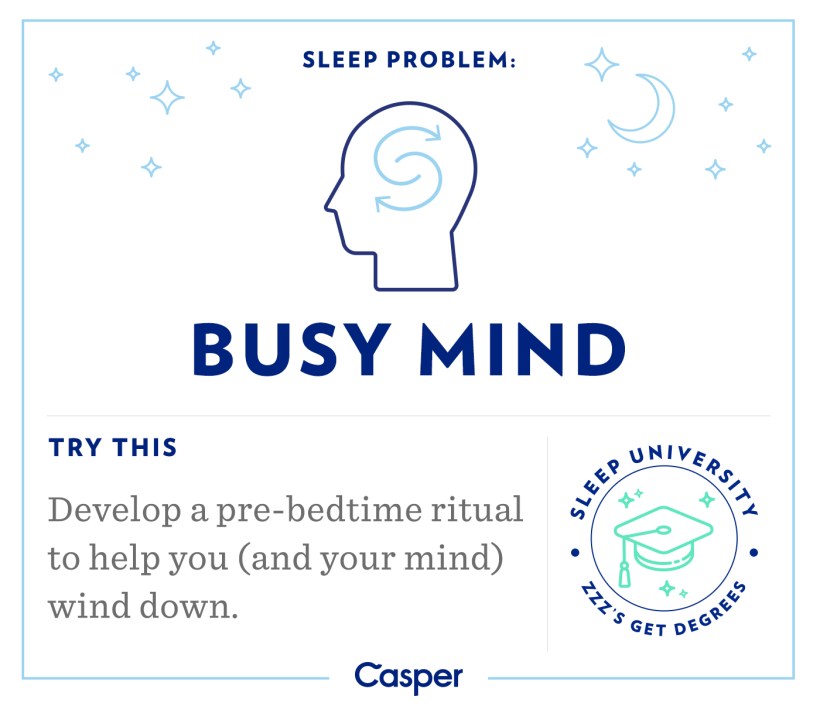
Busy Mind

Mental over activity is becoming a major issue for people, especially college students. We’ve all had those nights where it’s impossible to get our brains to slow down long enough for us to fall asleep. For busy college students these nights can happen more frequently. When you’re juggling so many different things at once, it can often feel like there is not enough time in the day to get everything done. This leads to many students working on schoolwork or participating in extracurricular activities up until bedtime. While this may not seem like a big deal, it’s actually a huge issue because sleep isn’t as simple as turning a switch off/on. Our bodies need time to unwind and dim our minds in order to prepare for sleep.

If you’re having trouble slowing your mind down at night, allow at least one hour before bed to wind down. This will not only help create closure for the day, but it also allows your brain to begin the process of shutting off. Developing a pre-bedtime ritual is a great way to help you and your mind wind down. Try reading, journaling, or even sketching and don’t forget to avoid electronics during your wind-down time.

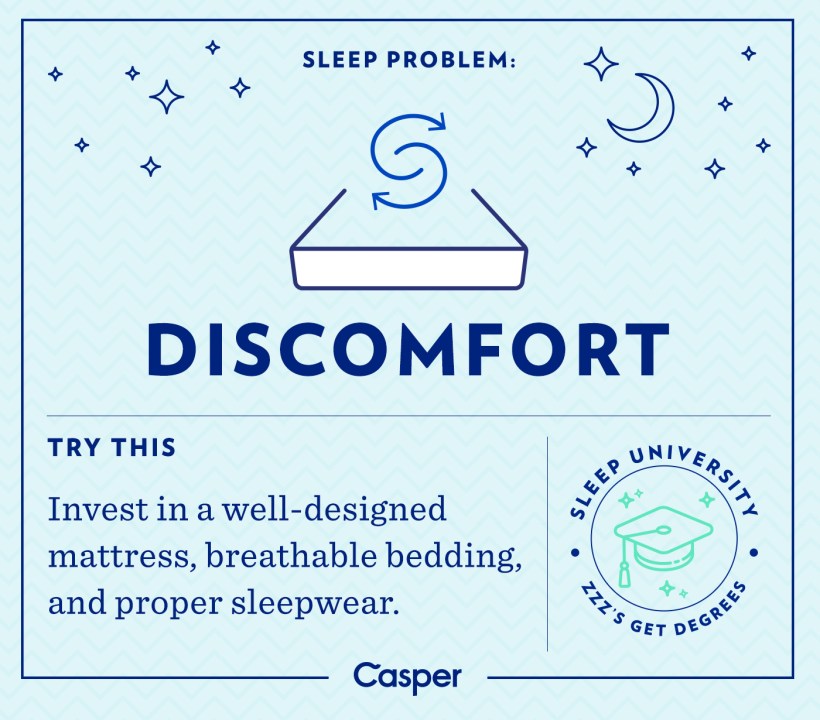
Discomfort

College dorm rooms come with their own set of sleep destroyers. One of the many reasons that college students have trouble sleeping in their dorm rooms is that their beds often have many other uses besides sleeping — including studying, doing school assignments, watching TV, and even hanging out with friends. Remember that although dorm rooms may be small, your bed is not your living room. You want to associate your bed with sleep so that when you see it your body craves sleep. Try to study at your desk or in the library and hang out with your friends in common areas. Another issue in your dorm room that may be causing problems with your sleep patterns is your university-issued mattress. Most of these mattresses have been used for years and may be too hard or lumpy. A poor quality mattress can cause discomfort and even body pains that can be distracting and prevent you from getting a good night’s sleep.

While you may not be able to go out and buy a new mattress for your dorm room, a mattress pad, comfortable bedding, and good sleepwear may help make it more comfortable. A soft and supportive pillow will also help add some much needed comfort to your bed.

Noise

Living in close quarters can make for a lot of noise. Whether it’s your roommate watching their favorite TV show at a high volume or your neighbors talking loudly in the hallway, noise can be extremely distracting when it comes time for bed. Unfortunately, while most resident halls have designated “quiet hours”, not all residents respect them. If your roommate and neighbors are continuously loud, especially during quiet hours, ask them to quiet down. It may even be helpful to discuss each other’s schedules and set guidelines to make sure everyone can sleep, study, and enjoy their time in the dorms peacefully. If that doesn’t work, try earplugs or white noise to help cover-up noises. Fans and sleep sounds are both great ways to cancel out noise.